Bartram's Blend
Gift set for investors to celebrate a local landmark's expansion project
Background
Bartram's Garden -- America's oldest living botanical garden, rooted along the Schuylkill River in Southwest Philadelphia -- was preparing to launch a National Capital Campaign. The board needed a "Thank You" gift for major donors: something that connected them to Philadelphia, the river, and the Garden itself, while genuinely celebrating Bartram's mission of building equitable, community-driven relationships between people and nature. Five strategic priorities anchored that mission -- horticulture, history, community and education, agriculture and food sovereignty, and enduring sustainability. Donors giving to a cause this significant deserved more than a consolation item -- more than something that communicates gratitude through its price tag alone. The gift had to work harder than that. The resulting gift must connect, tell a story, and earn a permanent place in someone's life rather than a corner of their shelf.
Objective:
To design a unique 'Thank You' gift for donors to Bartram's Garden's National Capital Campaign
Tools:
Adobe Illustrator, Adobe InDesign, Rhino, SolidWorks, Keyshot 3D
Inspiration
Three concepts shaped the project’s visual and material direction.
Watercolor botanical illustrations – Harnessing the Garden’s iconic collection of hand-drawn botanical illustrations. Focusing particularly on the Garden’s central symbols of the franklinia blossom and the golden ginkgo leaf.
Apothecary – The historical space where botany, science, and medicine intersect. Paying homage to Bartram’s contributions to natural science in the 1700s, and coinciding with the traditions and legacy of that era.
Origami – Both a decorative choice and a structural metaphor. Origami incites interaction. The act of unfolding evokes the idea of blossoming, mirroring the Garden’s flora and its current expansion mission. Visually, origami expresses simplicity and tradition.


Insights
The starting point was Bartram’s own language. The Garden doesn’t describe itself as a destination – it describes itself as an experience. If the Garden’s entire identity is built around immersive, community-driven experiences, then the gift couldn’t just represent that; it had to reproduce it. It had to create its own experience in the hands of the recipient.
From there, the research turned toward designed rituals, understanding the human-product interactions that carry meaning beyond their primary function. What separates a routine from a ritual? The answer, it turns out, is consciousness, tedium, and value. A routine is automatic. A ritual is chosen. And the best-designed rituals don’t add to your to-do list – they transform something you’re already doing into a moment worth having. A recent study found that four in five people wish they practiced more self-care, and 62% feel guilty about taking time for themselves. The opportunity wasn’t to add more – it was to make what already existed more meaningful.
Tea became the answer. It’s one of the few daily habits that already carries an inherent invitation to slow down… a gateway, as one source put it, to intention, reflection, and a kind of quiet mindfulness that most people want more of and rarely make room for. Utilizing the garden’s amenities, tea sits at the exact intersection of the Garden’s botanical heritage, its history in natural science and medicine, and its ongoing agricultural program.


Process
The packaging came first. Different origami folds were studied and prototyped not as aesthetics but as experiences – each fold produces a different rhythm of opening, a different physical sensation, a different moment of discovery. Petal-based forms were iterated against ginkgo-leaf forms, flower structures against layered geometries, until the shapes that felt most resonant surfaced. The goal was an unfolding that felt less like unwrapping and more like watching something bloom, a movement that echoed the Garden’s own language and gave the act of opening the gift its own distinct experience.
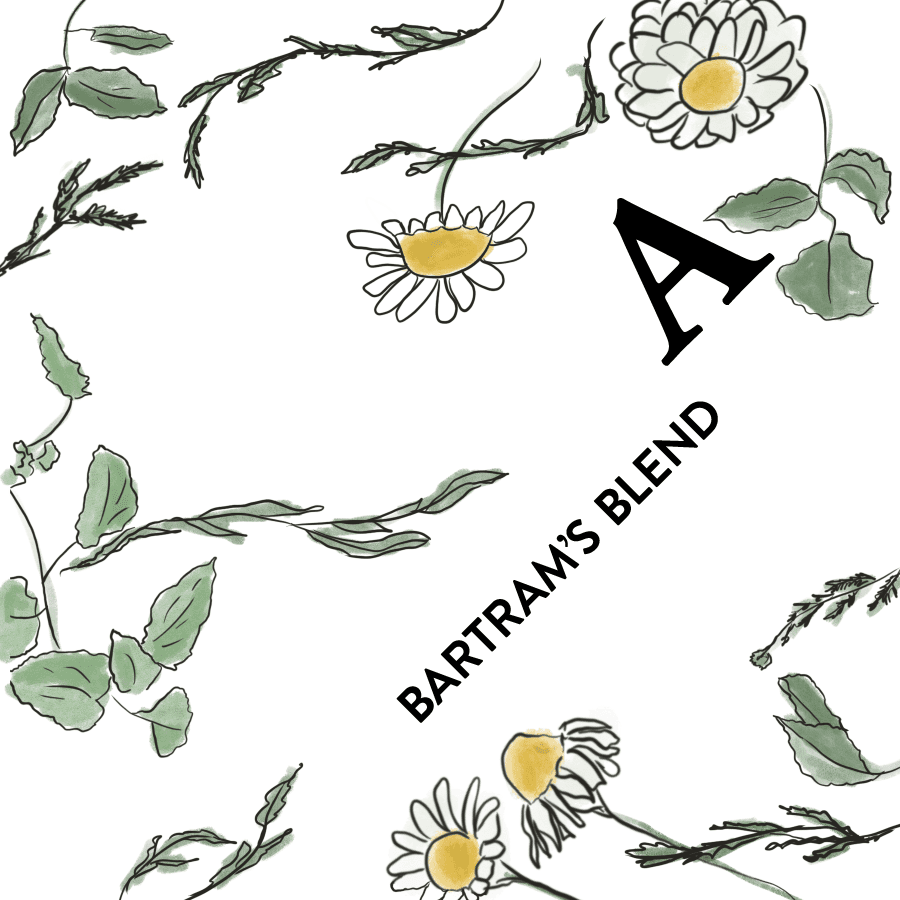
From there, the components were tied directly back to the Garden’s grounds. Each tea blend was named for a specific area of the site: the Historic Garden, the Sankofa Harvest, the White Orchard, the Luscious Meadow – so that the act of choosing a tea became an act of moving through the Garden itself. The botanical illustrations on each label referenced the specific flora grown in that area, grounding every sensory detail in something real and rooted.


Final Solution
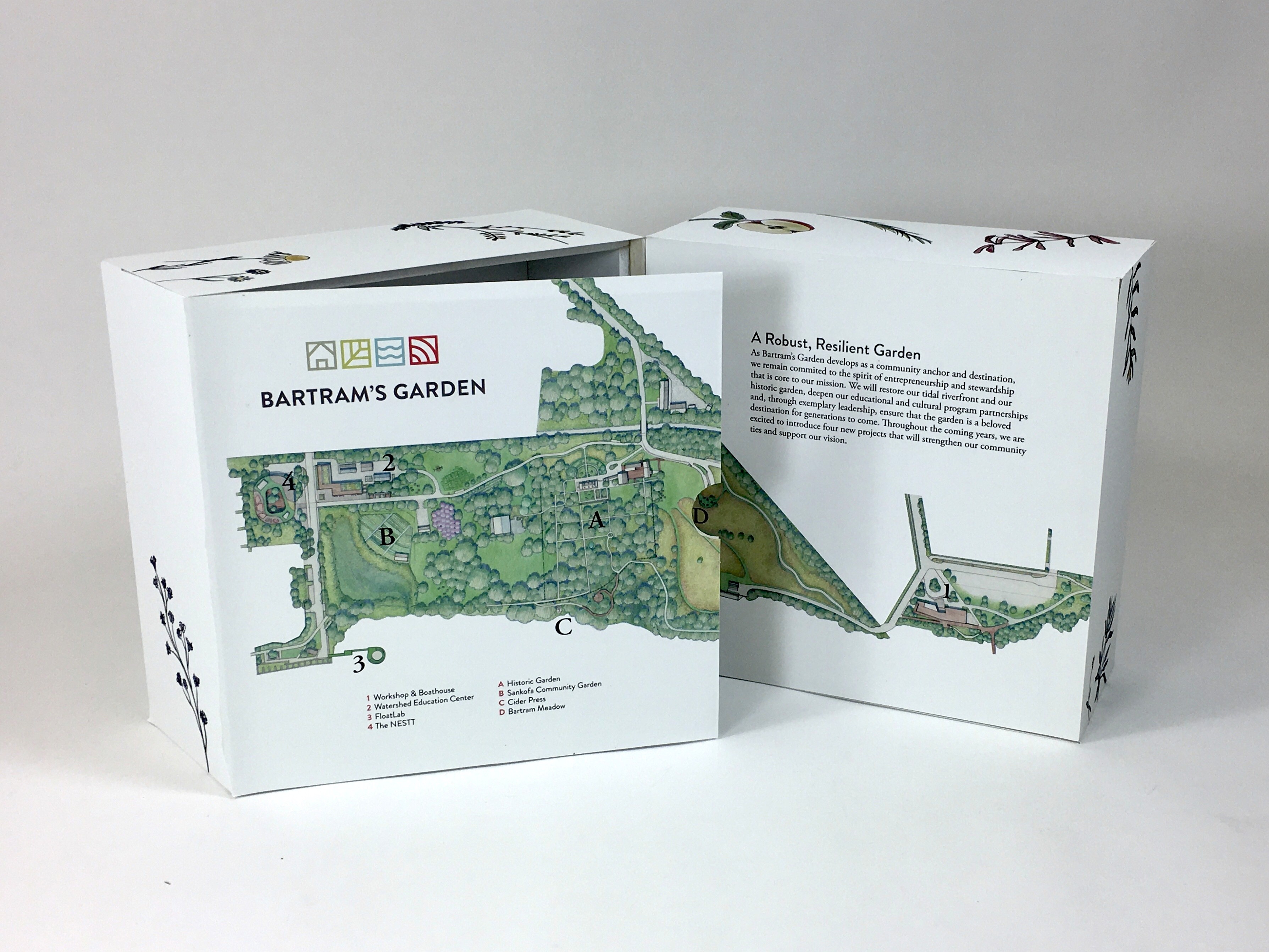
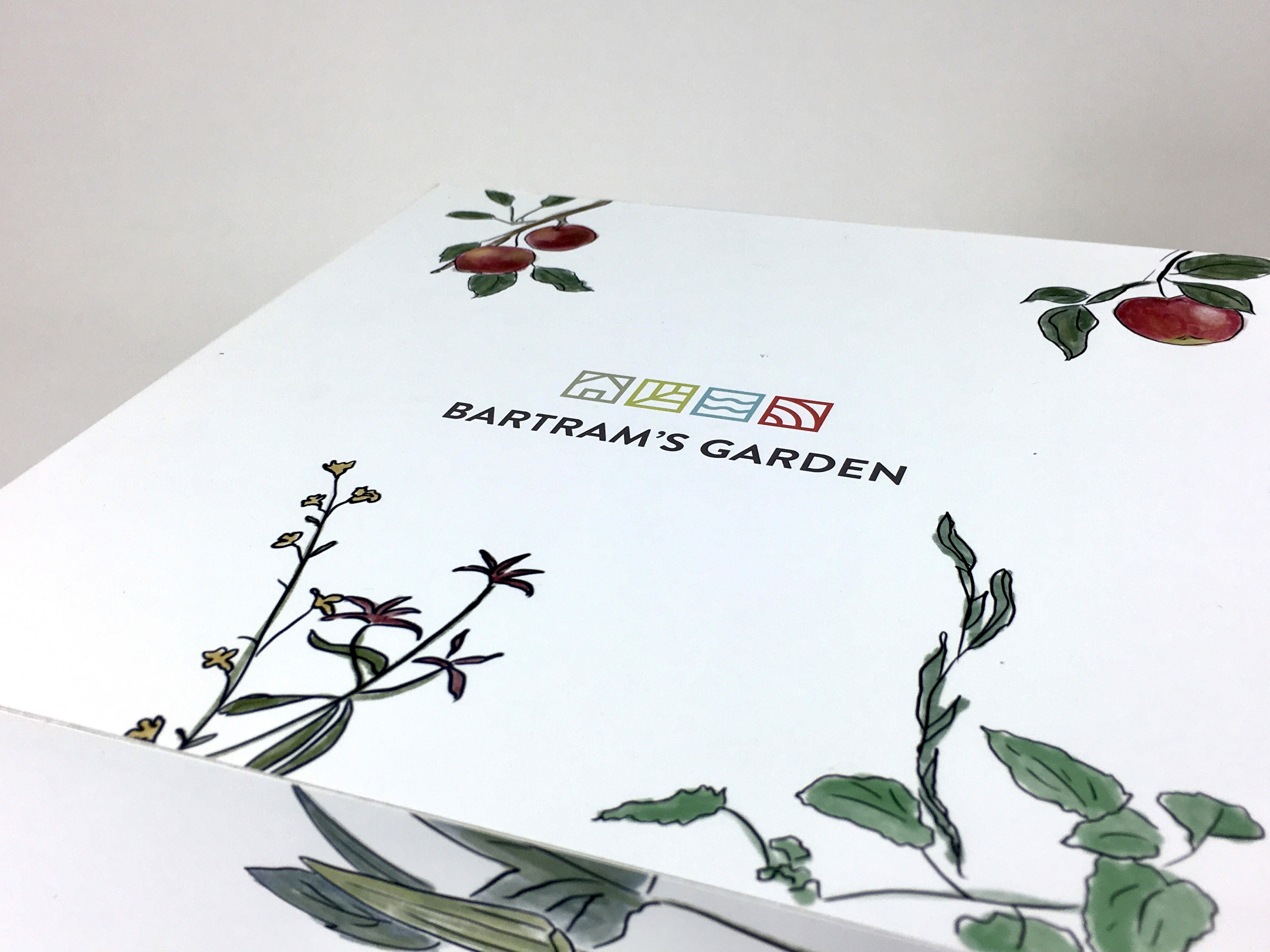
Bartram’s Blend brings together the Garden’s past, present, and future in a single object that tells its story in layers. The exterior greets with hand-rendered botanical illustrations in the tradition of Bartram’s own medicinal drawings – the visual vocabulary the Garden has always spoken. As the box unfolds, those illustrations give way to a full illustrated map of the Garden’s grounds, annotated with landmarks: the Workshop and Boathouse, the Watershed Education Center, the PlotLab, the NESTT. Deeper still, the inner flaps carry the Garden’s renovation plans and forward vision, so a donor isn’t just thanked – they’re let in.
At the center of it all is the BLOOM Tea Set. The strainer’s form unfurls like a franklinia blossom and a ginkgo leaf simultaneously – the Garden’s two most historically significant plants rendered as a functional, daily object. Alongside it: four test-tube samples of in-house teas, each named for a distinct corner of the Garden’s grounds, and a small jar of honey sourced directly from the Garden’s own apiary. Every component engages a different sense. Every detail traces back to something the Garden actually grows, does, or believes.
The whole thing is designed so that every time you use it, you’re not just making tea. You’re somewhere on those grounds. The gift doesn’t JUST REPRESENT Bartram’s Garden – it puts you inside it, one morning at a time.
Won 1st place. Judged by the panel of executives from Bartram’s Garden. Went into production.